Legacy Code / Week 3 / November 15, 2026
How to Stop Worrying About Money
Break the cycle of financial stress—and pass forward something better.
Does money control your mood, your decisions, or the conversations at home? You can learn different habits—and pass something better to the next generation.
Generosity That Grows · Pastor Chris Fluitt

The question behind the worry
What did you learn about money without anyone teaching you?
Maybe bills came in and everyone got quiet. Maybe money meant arguments, tears, or fear. Maybe the answer was always to swipe a card, borrow a little more, or avoid looking at the balance.
Nobody sat you down for a money lesson. But you learned one anyway. Now you earn, spend, owe, worry—and the people watching you may be learning the same cycle.
Financial stress can become a family tradition nobody intended to start.
How do I stop worrying about money? Start by facing your finances honestly, making a realistic plan, addressing debt, building savings as you can, and inviting God into your decisions. Financial peace does not mean pretending the bills aren’t real; it begins with wise steps you can actually take.
What if that cycle could stop with you? This message isn’t a request for your money. It’s an invitation to make wiser choices, trust God, and use what you have for good.

Free reflection resource
Want to Break the Cycle? Start Here.
You don’t have to figure everything out today. The free Legacy Code Workbook gives you space to reflect on what you’ve learned, identify what needs to change, and take your next step toward a healthier legacy.
Get the Free Legacy Code WorkbookListen and keep learning
Week 3 message resources

Listen to Pastor Chris Fluitt’s Week 3 message, then explore the biblical teaching and practical next steps below.
Download the Week 3 audio (MP3)
Read the Week 3 Message Outline (PDF)Download the Free Message Handout (PDF)01 / Matthew 6:24–34
Money makes a terrible master.
Jesus says we cannot serve both God and money (Matthew 6:24). Money is a useful tool, but a terrible boss. When it becomes our master, we can feel anxious, jealous, afraid, or controlled by the next bill.
Pastor Chris shares a personal story about selling a condo while buying a house. He initially thought a $10,000 profit was possible. In prayer, he sensed God asking, “Aren’t you going to ask Me?” He waited, and the eventual sale produced a $100,000 profit. He describes listening to God as a $100,000 decision.
That is his testimony—not a formula for making money, a promise about property values, or a guarantee that prayer produces financial gain. The point is to invite God into important decisions rather than simply asking Him to bless decisions we’ve already made.
In Matthew 6:25–34, Jesus addresses worry about food, clothing, and everyday needs. His call to seek God’s kingdom first does not mean ignoring debts, skipping a budget, or pretending a problem isn’t real. Trust and wisdom belong together.
Don’t just ask God to bless your financial decisions. Invite Him to lead them.
02 / Proverbs 22:7; 21:20; 13:11
Wise money habits create financial freedom.
Proverbs 22:7 warns that the borrower is servant to the lender. You know the pressure: an old vacation still on the credit card, furniture payments, or Christmas gifts you’re paying for months later. Debt can make tomorrow pay for what you want today.
Financial freedom isn’t about showing off wealth. It’s about having room to breathe, plan, and be generous. Start with four habits worth passing on.
1. Get out of debt
List what you owe, especially high-interest balances. Consider the debt snowball: pay minimums on each debt while putting extra money toward the smallest balance.
2. Build an emergency fund
Begin with a $1,000 starter goal from the sermon, then grow savings as circumstances allow. A car repair shouldn’t automatically become new debt.
3. Save and invest
Set aside money consistently for future needs and retirement. Think long-term, not get-rich-quick. Proverbs 13:11 commends gradual, steady growth.
4. Practice generosity
Make room to bless others with what you have. Generosity can be intentional even when your budget is modest; it is not a promise of financial return.
Proverbs 21:20 praises wise storing of resources. Luke 6:38 calls us toward generosity, but it should not be read as a guaranteed investment return. Healthy habits help us say no to some things so we can say yes to what matters.
03 / Matthew 25:14–30
What you do with what you have matters.
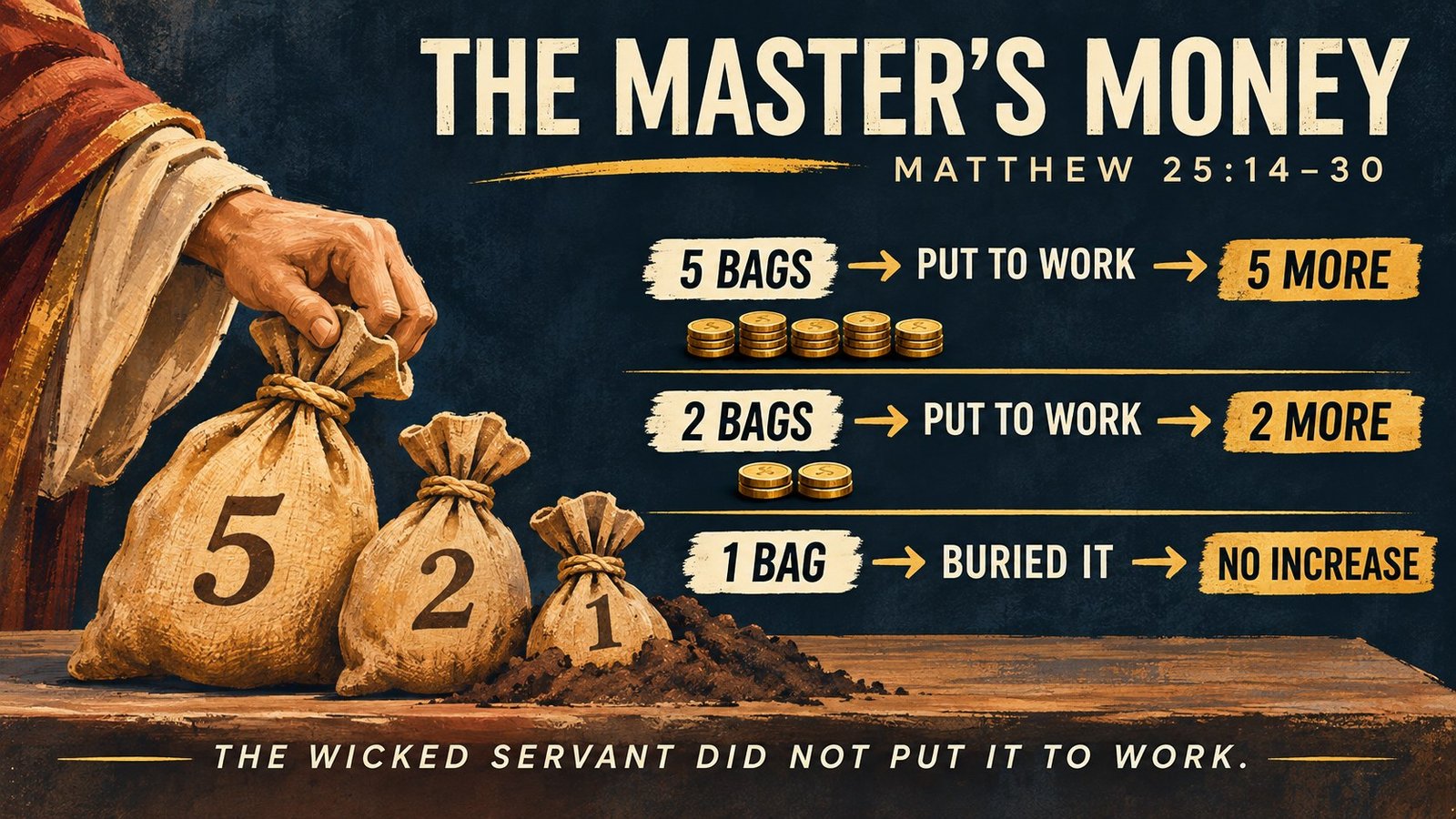
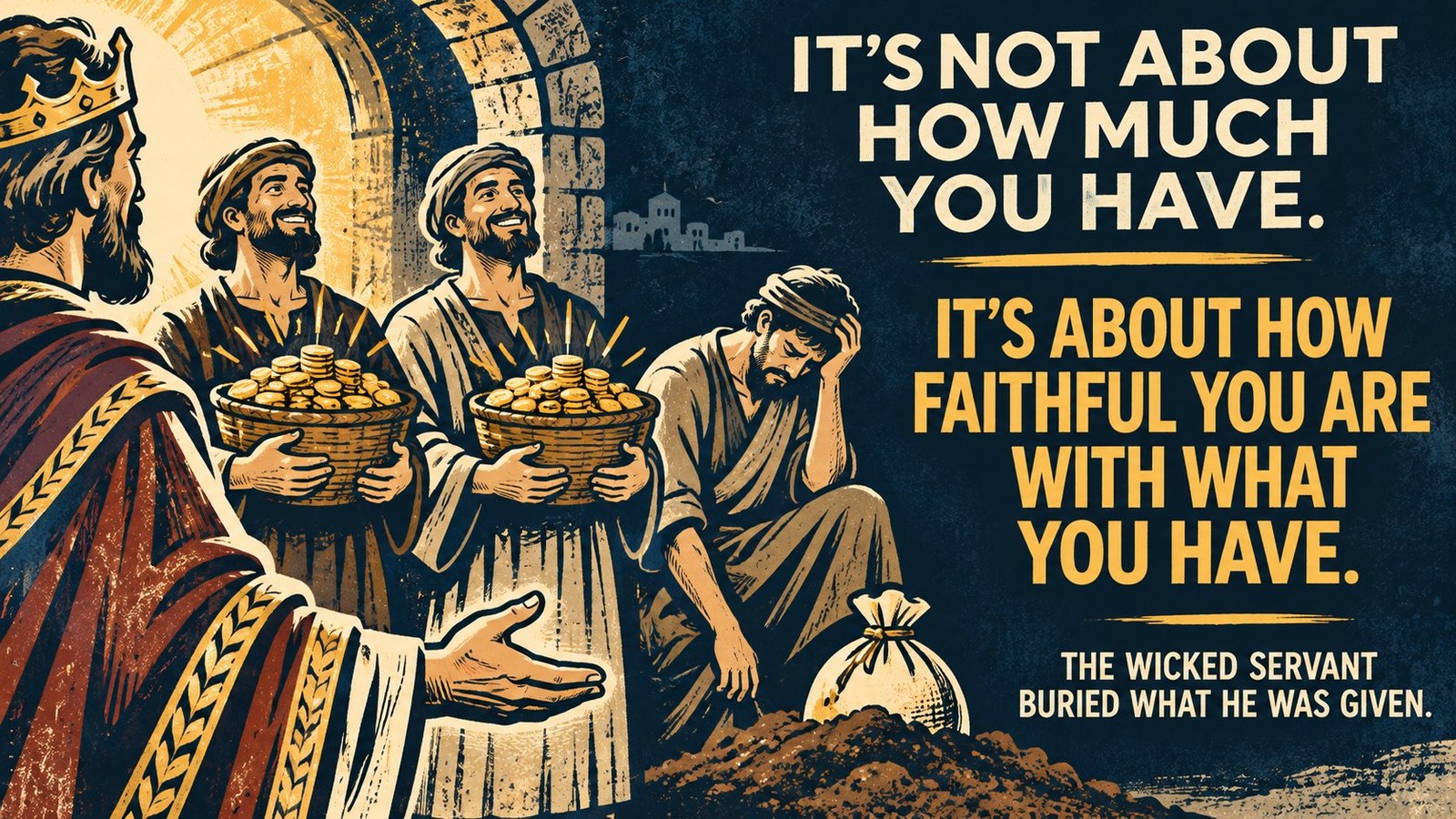
Jesus tells a story about a master who entrusted resources to three servants. One received five bags, another two, and another one. The first two put what they received to work. The third buried his bag out of fear and did nothing.
The resources belonged to the master. The servants were responsible for what they did with them. This parable is about faithfulness and responsibility, not a command to pursue risky investments or a promise that everyone will become rich.
It’s not about how much you have. It’s about how faithful you are with what you have.
Ask yourself: Am I managing what I’ve been given? Preparing for the future? Using my resources to bless someone? Or am I letting fear keep me from taking any step at all?
The goal isn’t just to grow what you have. It’s to grow the good you can do.
More valuable than money
What God has given us cannot be bought.
Philippians 4:19 points to God’s provision in Christ. And 2 Corinthians 8:9 points us to the generosity of Jesus. He died for our sins, was buried, and rose again. Through Him we receive forgiveness, new life, and the Holy Spirit.
That’s the gospel. Not a financial shortcut. Not a guarantee of comfort. Something greater than money can buy.
Don’t bury what God has given you. Put it to work.
This week, not someday
Three steps to begin breaking the cycle
1. Face the numbers
Write down your income, expenses, debts, balances, minimum payments, and interest rates. You can’t fix what you refuse to face.
2. Make a plan
Choose a workable budget, a debt strategy, and an emergency-savings goal. If you need help, seek trustworthy financial counsel.
3. Ask God—and teach someone
Pray before major decisions. Let the next generation see saving, wise spending, honest conversations, and generosity.
Don’t pass down financial fear. Pass forward financial freedom.
Don’t just read about change. Take your next step.
Use the free Legacy Code Workbook to reflect on what matters most and begin putting these principles into practice.
Get My Free WorkbookOne step is enough to begin. Maybe yours is opening the bill you’ve been avoiding, talking with your spouse, making a budget, or asking someone for help.
Reflection and spiritual response
What will you pass forward?
Where has fear, greed, or avoidance shaped your decisions? What financial habit did you inherit? What one different habit could someone learn by watching you this week?
Bring those things to God. Surrender what has become your master. Repent where you need to. Ask Jesus for new life and wisdom, then take one concrete step toward financial freedom. You do not have to have everything figured out before asking for prayer.
Questions people really ask
Money, worry, and faith: FAQs
Does trusting God mean I shouldn’t worry about bills?
Jesus invites us not to be ruled by worry (Matthew 6:25–34), but trust doesn’t mean ignoring reality. Know what you owe, make a plan, and ask for help when you need it.
Is having debt a sin?
The Bible warns about the power debt can have over our choices (Proverbs 22:7). Not every debt is the same, and being in debt does not make you less loved by God. Start with an honest assessment and a realistic repayment plan.
Should I give to church when I’m struggling financially?
Generosity is about the heart, not pressure or a transaction. Caring for basic needs and meeting obligations matter. Don’t give because someone promises that God will make you rich in return.
How do I start saving when I barely have enough?
Start by seeing your numbers clearly. Look for one manageable change, however small. The sermon suggests $1,000 as a starter emergency fund, not a requirement to reach immediately.
What does the parable of the talents teach about money?
Matthew 25:14–30 emphasizes faithful stewardship of what is entrusted to us. Its central question isn’t how much you possess, but whether you respond responsibly and faithfully.
How can I teach children healthy money habits?
Talk honestly in age-appropriate ways. Show them how you plan, save, give, and seek God’s wisdom. Children often learn more from what they observe than from formal lessons.
Keep building a different legacy
Explore the full Legacy Code series

From Pastor Chris
Let’s talk about your next step.
Thanks for taking the time to check out this important message! Money can be a source of stress, worry, and even fear. But I believe God has something better for us—and for the generations coming after us. My hope is that this message encourages you to trust God, make wise decisions, and take one step toward financial freedom. You don’t have to figure it all out today. If you have questions, need prayer, or just want to talk about your next step, I’d love to hear from you. Seriously, send me a text!
Pastor Chris Fluitt
Real people. Real questions. Real hope.
You’re welcome at FCC Allen.
Questions about faith, money, family, or your next step? You are welcome here. Join us for worship on Sundays at 10:30 AM.
First Christian Church of Allen
1207 Twin Creeks Dr., Allen, TX