VALID FAITH · QUESTION 2
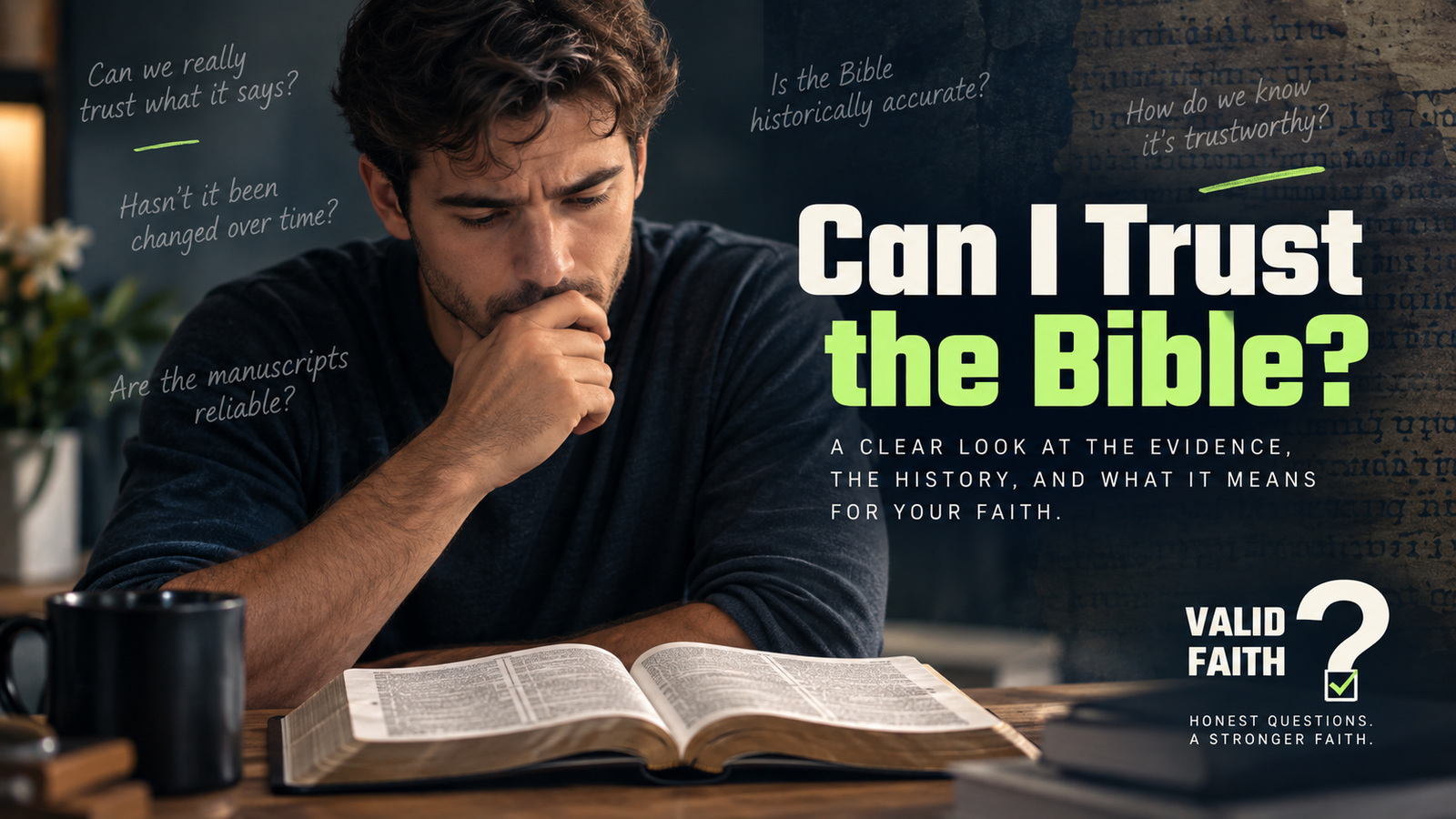
Can I Trust the Bible?
A clear look at the manuscripts, the canon, the Dead Sea Scrolls—and why the Bible’s history can withstand honest questions.
An honest investigation
We live in a crisis of trust.
Institutions disappoint us. Media contradicts itself. AI can manufacture faces and voices that look completely real. So when someone asks, “Can I trust the Bible?” that is not a foolish or faithless question. It is one worth investigating.
Special guest Jon Hiesberger does not approach this as a detached academic exercise. Through anxiety, depression, fear, and dark seasons, he learned to depend on God’s Word personally. For Jon, the question is both historical and deeply human: Is this Word reliable enough to build a life on?
The Bible claims that God watches over His Word and that His Word will not fail (Jeremiah 1:12; Luke 1:37). But Christianity does not ask us to stop there. The history of the text gives us evidence we can examine.
Two terms worth knowing
What are manuscripts and the canon?
Manuscript
A manuscript is a handwritten ancient copy of a biblical text—sometimes a small fragment, sometimes a whole book, and sometimes a collection of books on papyrus or parchment.
Canon
The canon is the recognized collection of writings received as Scripture—the books early believers treated as authoritative, copied, read in churches, and distinguished from other religious writings.
A large, testable body of evidence
Thousands of witnesses—not one fragile copy.
Jon’s message points to more than 5,800 Greek New Testament manuscripts, more than 18,000 additional witnesses in ancient languages, and more than one million New Testament quotations in early Christian writings.
The large number matters because copies found across different centuries, languages, and regions can be compared with one another. A sweeping rewrite could not be quietly inserted everywhere: differences show up in the evidence, and the broad agreement among the witnesses allows scholars to identify where copying variations occurred.
That is very different from a “telephone game.” The Bible did not pass through one undocumented chain of whispers. It survives in a wide, geographically distributed body of written evidence that can still be studied.
The Old Testament
The Dead Sea Scrolls
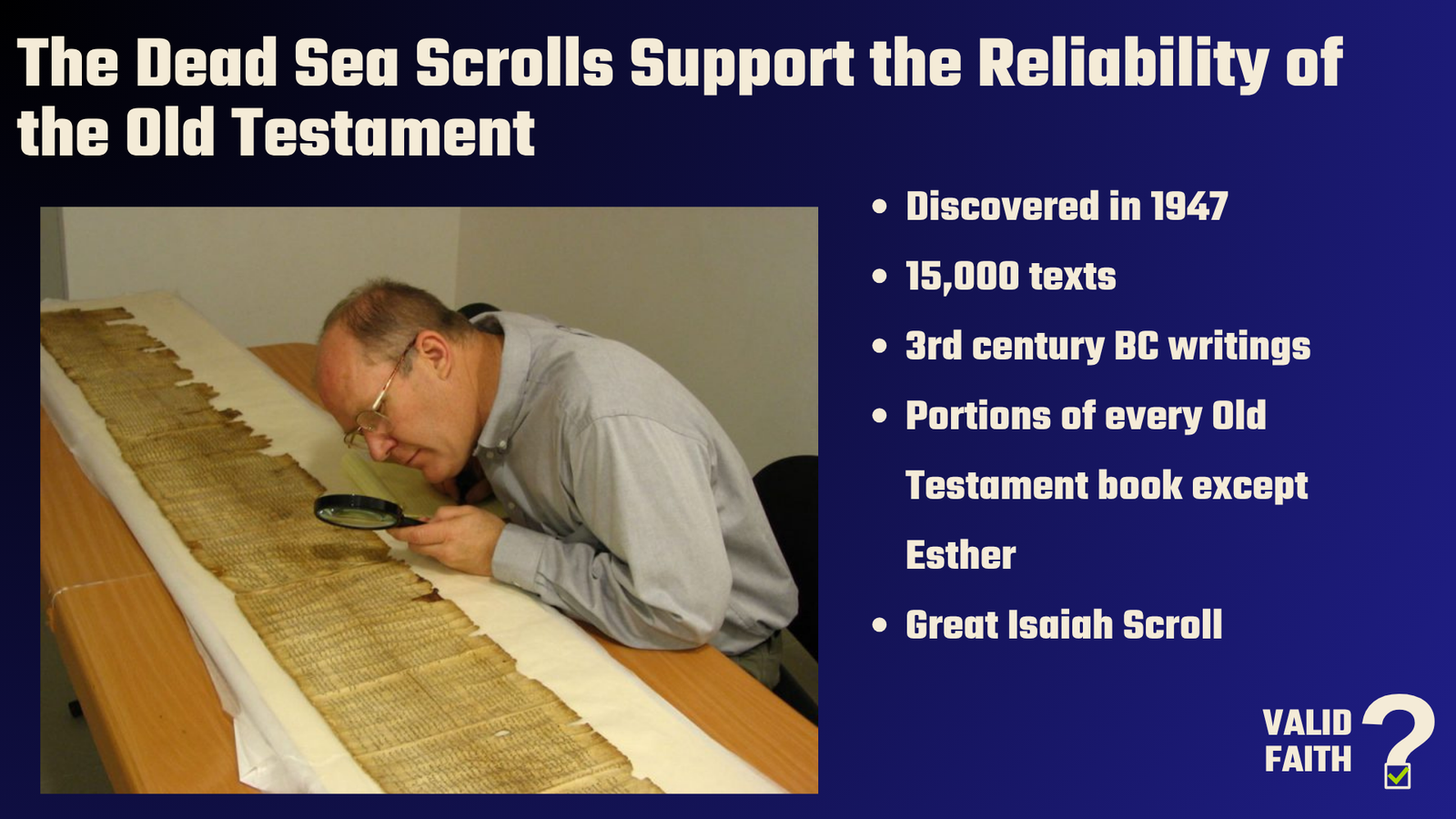
Discovered beginning in 1947 near Qumran, the Dead Sea Scrolls include portions of every Old Testament book except Esther and pushed surviving Hebrew biblical evidence back roughly a thousand years. The Great Isaiah Scroll, dated to around 125 BC, contains essentially the whole book of Isaiah and is remarkably consistent with the much later Masoretic tradition—powerful evidence that the Old Testament text was preserved rather than reinvented by Christians.
The New Testament
The Muratorian Canon
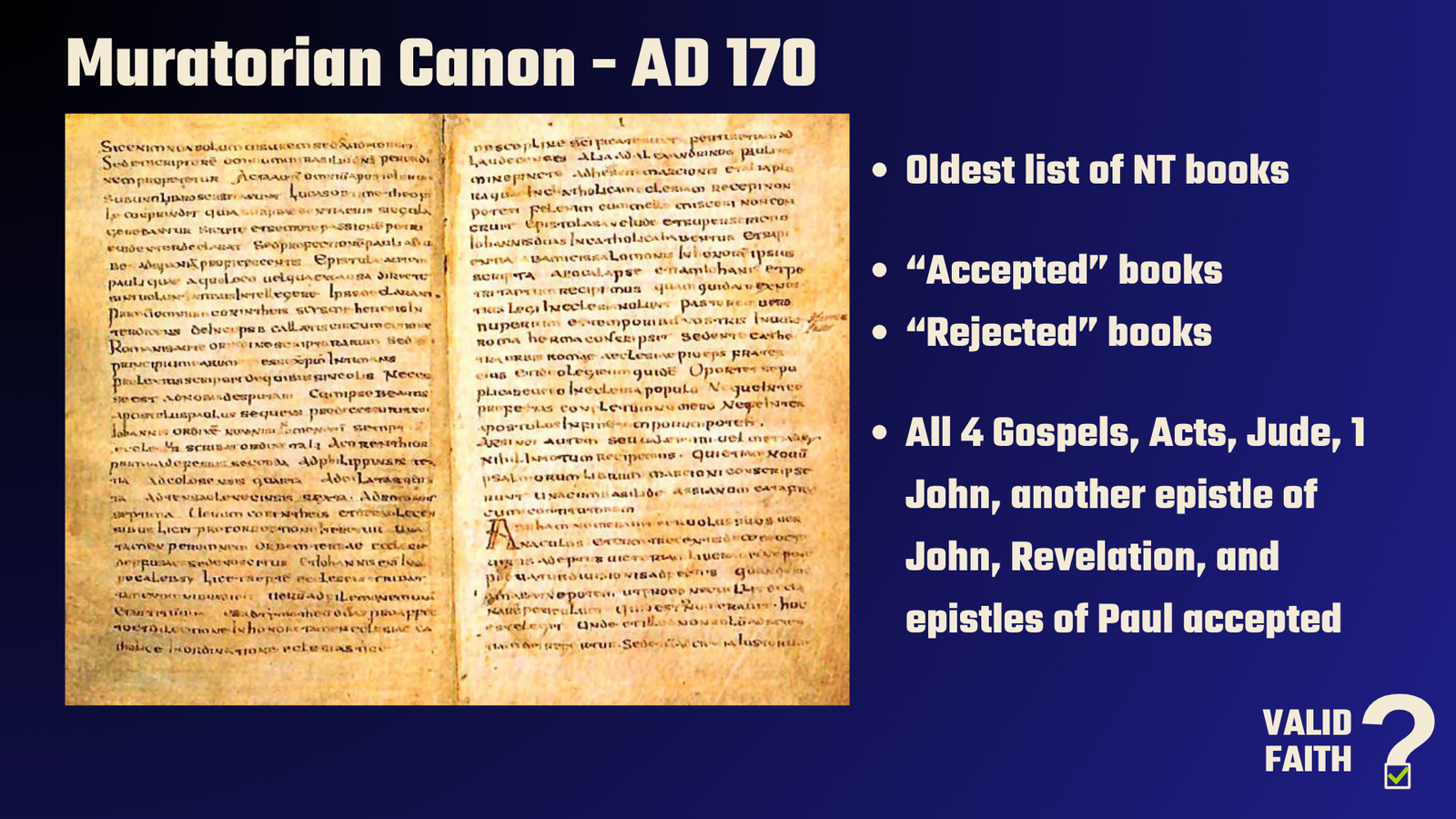
The Muratorian fragment, commonly dated to the late second century and often summarized as about AD 170, is an early list distinguishing accepted Christian writings from rejected ones. It recognizes all four Gospels, Acts, Paul’s letters, Jude, writings of John, and Revelation—showing that Christians were already identifying an authoritative core long before later church councils.
Why the early date matters.
The New Testament evidence reaches unusually close to the events it reports. Jon contrasts that with other ancient works that survive in only a handful of copies made many centuries after their originals. The comparison does not prove every Christian claim by itself, but it does show that dismissing the New Testament merely because it is ancient applies a standard historians do not use consistently elsewhere.
The earliest churches received apostolic teaching, read it publicly, shared it, translated it, and copied it. The evidence is abundant enough to examine rather than simply take on someone else’s word.
More than information
Jon’s reason is personal.
Jon grew up without a father and carried unusual anxiety, obsessive worry, fear, and isolation. Reading about God began a conversation. That search led him to people of faith, to church, and eventually to a simple prayer: “God, would You be my Father?”
Later, when dark nights returned and emotions clouded his thinking, he came back to Scripture—not merely reading it, but trusting and applying it. His case for the Bible is not only that the text survived. It is that God used that Word to lead him to Jesus, sustain him, and change his life.
The Bible is not merely another self-help book. It connects us to the One who can transform us.
How to rely on God’s Word
Absorb. Agree. Align.
1. Absorb
Read God’s Word. Take it in. Let it feed you, shape your imagination, and become part of how you see the world.
2. Agree
Choose to trust what God says even when your feelings, culture, or limited understanding pull in another direction. Agreement opens the heart to repentance.
3. Align
Bring your actual life into line with Scripture. Do not merely hear the truth—live it, even when obedience is difficult.
Listen to the message
Can I Trust the Bible?
Hear Jon Hiesberger’s complete Valid Faith message from First Christian Church of Allen.
More from Jon Hiesberger
Keep the conversation going with Apologetics Media.
Jon’s new YouTube channel explores the Bible, Christian faith, reason, and honest questions. Scan the QR code or use the button to visit and subscribe.
Keep asking
Take the conversation home.
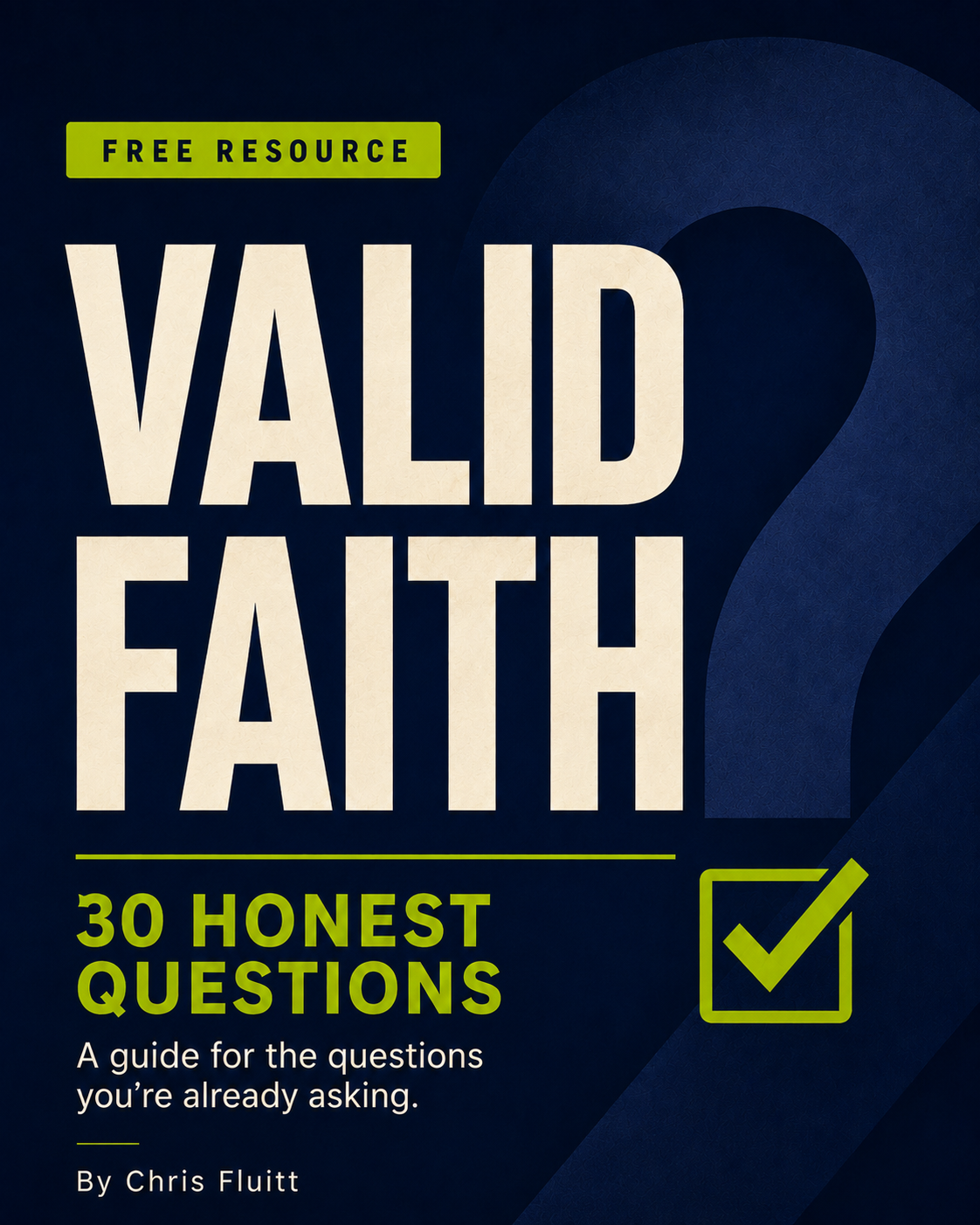
Get the free Valid Faith edition of 30 Honest Questions—short starting points for questions about God, science, suffering, Jesus, the Bible, morality, doubt, church hurt, and more. Fill out the short form and we’ll send it straight to your inbox.
Common questions
Questions about trusting the Bible
Has the Bible been changed over time?
Thousands of manuscripts from different regions and periods allow scholars to compare the text. Copying variations exist, but their visibility is part of the evidence: they can be identified and evaluated rather than hidden.
Did church leaders simply choose the books they preferred?
Early sources such as the Muratorian fragment show that Christians were recognizing and distinguishing authoritative writings in the second century, while Christianity was still vulnerable and often persecuted—not centuries later as a convenient tool of political control.
What do the Dead Sea Scrolls demonstrate?
They provide biblical manuscripts from before and around the time of Jesus, including an essentially complete Isaiah scroll, and show substantial continuity with the Hebrew textual tradition preserved many centuries later.
Can I follow Jesus while I still have questions?
Yes. Honest questions do not disqualify you from seeking truth. Valid Faith is for believers, skeptics, people rebuilding faith, and anyone willing to investigate.

Meet Pastor Chris Fluitt
Questions are welcome here.
Chris Fluitt is a pastor at First Christian Church of Allen and the host of the Valid Faith conversation. He wants FCC Allen to be a place where people can bring honest questions about Jesus, the Bible, faith, and doubt—and talk them through without pretending the questions are easy.
If this message raised a question for you, Chris would be glad to hear from you personally. Send him a text and tell him what you are thinking.
Continue Valid Faith
Keep reading. Keep trusting. Keep growing.
God’s Word has not changed—but through it, people’s lives can. Explore the complete series and continue the conversation.